Is Coral Casino Safe? UKGC Licence and Player Protection
 Available in GB
Updated: 11 September 2026. Coral’s Great Britain online casino operation is linked in the UK Gambling Commission public register to LC International Limited, account 54743. The register shows the operator’s Casino Remote licence 054743-R-330863-014 as Active and Current, and the separate trading-name record lists coral as Active. That is strong primary-source evidence that the Coral brand is connected to a currently licensed remote casino operator for Great Britain.
That does not make gambling risk free and it does not guarantee a particular withdrawal, complaint outcome, support experience or game result. Licensing is better understood as evidence of regulatory oversight. For the broader product picture, see the Coral Casino UK review; for the practical identity-check process, use the Coral KYC guide.
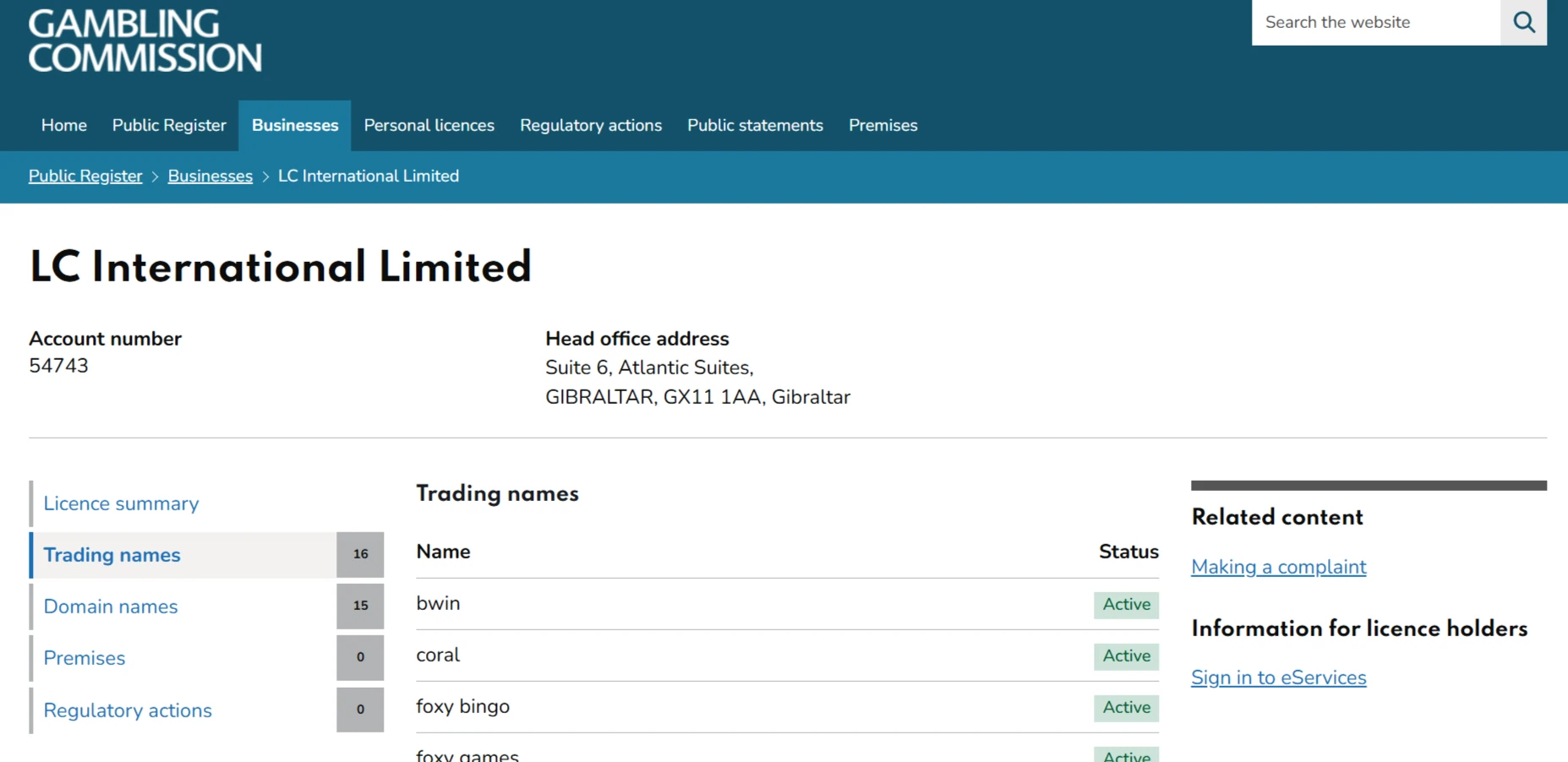
Table of Contents
- The regulator evidence in two separate records
- Great Britain is the precise regulatory scope
- What the licence changes for a player
- Coral’s own safer-gambling controls
- GAMSTOP is broader than a single Coral account
- Payment protection includes a credit-card ban
- Financial vulnerability checks: what the £150 threshold means
- Regulatory change scheduled for 30 September 2026
- Licence status and customer reputation are different questions
- Complaints: keep evidence and separate the issue
- UK tax context for ordinary gambling winnings
- Bottom line: is Coral Casino safe?
- Coral licence and safety FAQs
The regulator evidence in two separate records
A useful trust check separates the legal operator from the consumer-facing brand name. The UKGC register does exactly that. The business summary for LC International Limited identifies account 54743 and lists several remote activities. The casino entry is shown as Casino Remote 054743-R-330863-014 with an Active status and a current end date. The trading-name page for the same account separately lists coral as Active.
| Question | UKGC register position on 11 September 2026 | Why it matters |
|---|---|---|
| Who is the operator? | LC International Limited | Connects the consumer brand to the legal gambling business |
| What is the UKGC account? | 54743 | Provides a regulator reference that can be checked independently |
| Is remote casino activity licensed? | Casino Remote 054743-R-330863-014 – Active, Current | Shows that the account includes the relevant remote casino activity |
| Is Coral attached to that account? | coral – Active trading name | Links the brand name seen by players to the registered operator |
You can verify the records directly in the UKGC licence summary and the separate UKGC trading-name record. The distinction matters because a logo or website footer by itself is weaker evidence than a current regulator register entry.
Great Britain is the precise regulatory scope
The Gambling Commission says its operating-licence remit covers gambling businesses operating in Great Britain and remote gambling products offered to consumers in Great Britain. In this context, Great Britain means England, Scotland and Wales. The Commission also states that it does not regulate the provision of remote gambling in Northern Ireland under the same framework, although there are separate rules concerning advertising remote gambling there.
The blanket phrase “fully legal across the UK” would be inaccurate. Coral’s LC International Limited account holds an active UKGC remote casino licence relevant to Great Britain. Northern Ireland has a separate gambling-law framework, so UKGC status should not be stretched into a claim about every form of gambling regulation across the entire United Kingdom.
The underlying Great Britain framework is based on the Gambling Act 2005 as amended. The practical point for a player is simpler: a remote casino serving Great Britain needs the appropriate Gambling Commission operating licence, and the current register shows that LC International Limited holds one.
What the licence changes for a player
A licence is not a quality award. It is a regulatory relationship with enforceable requirements. For a customer deciding whether a site is trustworthy, the most useful question is not “does a licence make every experience safe?” but “what controls sit behind the licence and can I verify them?”
Several protections are relevant to Coral customers in Great Britain:
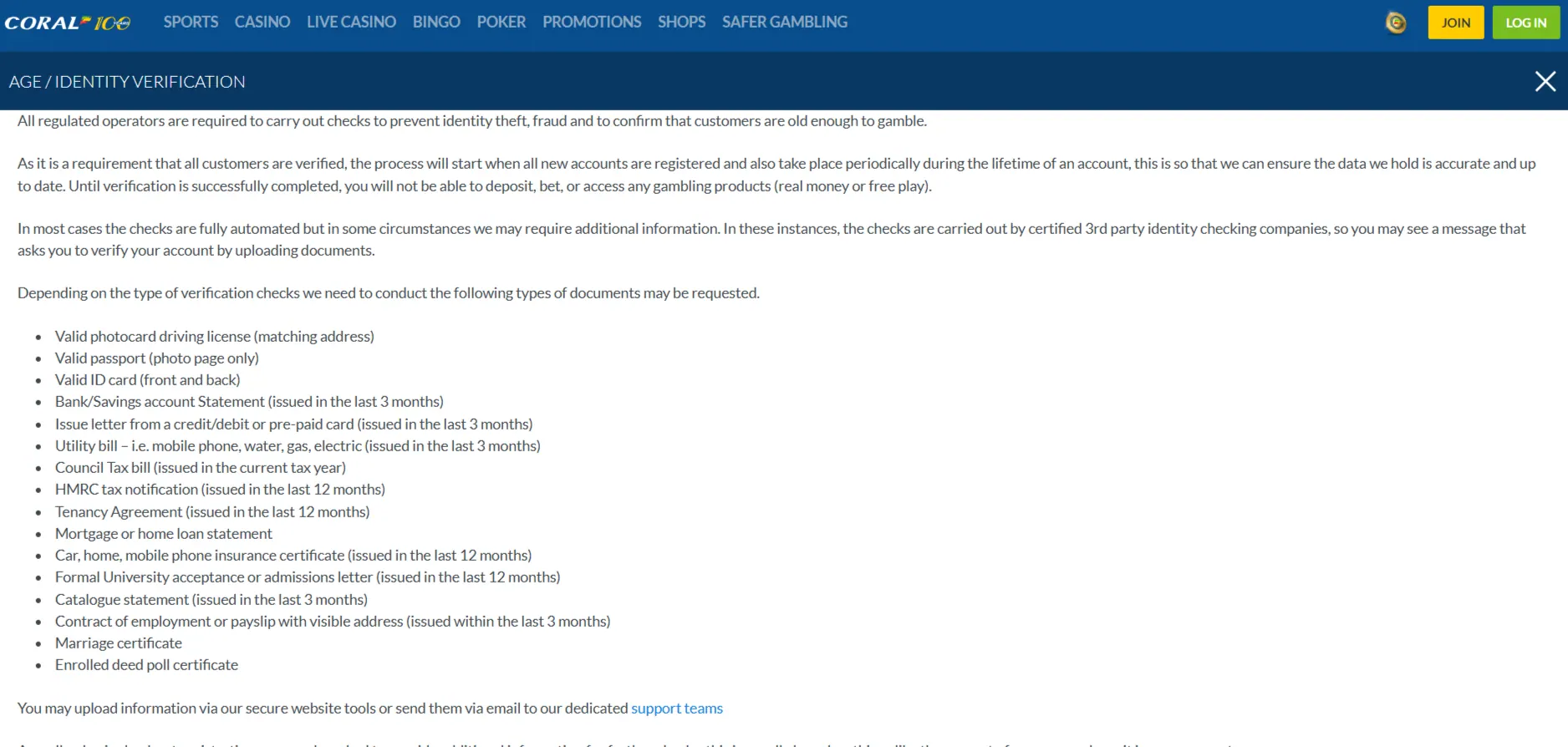
- Age and identity verification. UKGC rules require online gambling businesses to verify age and identity before a customer gambles. Coral also requires age and identity verification and can restrict access until verification succeeds.
- Cross-operator self-exclusion. GAMSTOP Online is used across online gambling companies licensed in Great Britain. Coral’s own safer-gambling material links customers to GAMSTOP as the wider self-exclusion route.
- Credit-card restriction. Great Britain rules prohibit credit cards for online casino gambling and require operators to prevent credit-card funds being routed through e-wallets.
- Financial vulnerability checks. The current UKGC rule requires specified public-record vulnerability checks when deposits minus withdrawals exceed £150 in a rolling 30-day period, subject to the rule’s exceptions.
- Customer-set controls. Coral provides tools including deposit limits, reality checks, time outs and self-exclusion.
These controls address different risks. Identity verification is not the same thing as a financial vulnerability check, and a deposit limit is not the same thing as self-exclusion. Treating them as separate layers gives a more accurate picture than using one generic “responsible gambling” label.
Coral’s own safer-gambling controls
Coral’s current gambling-controls page provides several account-level tools. Deposit-limit settings are designed to control how much can be deposited over a chosen period. Reality checks provide time-based alerts during play. Time Out offers a temporary break, while self-exclusion is intended for a longer restriction from gambling. Coral also points UK residents to GAMSTOP for a broader block across participating Great Britain-licensed online gambling businesses.
The practical choice depends on the problem being solved. A spending limit is useful when the intention is to keep deposits within a predetermined budget. A reality check is about awareness of time spent playing. A time out is a deliberate temporary stop. Self-exclusion is the stronger option when continued access itself is the problem.
These tools should be used before gambling becomes difficult to control, not treated as evidence that losses can be recovered later. If you are opening an account and want to understand where verification fits into the journey, see the Coral registration guide.
GAMSTOP is broader than a single Coral account
GAMSTOP Online is a national self-exclusion mechanism used by online gambling businesses licensed in Great Britain. Its current guidance says licensed online gambling companies must check the service when a person tries to register or log in, and companies with an existing account are required to check self-exclusion status daily.
That makes GAMSTOP different from closing or restricting only one Coral account. Coral’s own site-level tools operate within Coral or related account settings, while GAMSTOP is designed to prevent access across Great Britain-licensed online operators. The two approaches can therefore sit at different levels of the same safer-gambling framework.
For a player assessing trust, the important point is not simply that a safer-gambling page exists. It is that Coral’s controls sit alongside an external multi-operator self-exclusion system required across the licensed Great Britain online market.
Payment protection includes a credit-card ban
The Gambling Commission’s credit-card rule prohibits Great Britain operators from accepting credit cards for online betting, casino and bingo. The guidance also requires operators that accept e-wallet payments to make sure the money was not loaded from a credit card. This is a market-wide consumer-protection rule, not a Coral bonus condition or a temporary promotion restriction.
It should not be confused with the list of payment methods Coral currently supports. Cards and e-wallets can have different eligibility rules, account checks and promotional treatment. For a payment-method decision, see the dedicated Coral payment methods page rather than using the licence page as a cashier guide.
Financial vulnerability checks: what the £150 threshold means
The current UKGC Licence Conditions and Codes of Practice set a financial vulnerability threshold at deposits minus withdrawals exceeding £150 in a rolling 30-day period. At that point, subject to specified exceptions, a remote operator must carry out a customer-specific public-record check for significant indicators of potential financial vulnerability.
The rule includes indicators such as bankruptcy and specified court or debt records. It should not be described as a conventional credit-score check, and the threshold does not mean that £150 is a legal monthly gambling allowance. It is a regulatory trigger for a particular light-touch check. The operator must consider the information it obtains alongside other permitted information and take proportionate action where risk is identified.
This distinction is important because a trust page can otherwise make the rule sound more intrusive or more permissive than it is. The £150 figure is a check threshold, not an endorsement of spending at that level.
Regulatory change scheduled for 30 September 2026
Status on 11 September 2026: not yet in force. The Gambling Commission has scheduled a second phase of financial-limit rules for 30 September 2026. From that date, operators must offer gross deposit limits, only gross deposit limits can be called “deposit limits”, and those limits must receive at least equal prominence to other financial-limit types.
This date matters because Coral’s current controls page uses both gross-style and net-style concepts. The regulatory terminology is about to become more standardised. On or after 30 September 2026, check the live Coral controls and the final UKGC rules because the interface terminology may change.
Licence status and customer reputation are different questions
A common review mistake is to mix regulator evidence, customer complaints and star ratings into one safety score. They answer different questions. The UKGC register can establish operator identity, licensed activities and licence status. Customer reviews can describe individual service experiences, but they do not change what the regulator register says. Equally, an active licence does not prove that every customer has had a positive experience.
Third-party review scores should not be used as evidence that Coral is licensed or trustworthy. If you read complaint sites or app-store reviews, treat them as dated sentiment. Look for repeated themes, the date of the review and whether the complaint concerns identity checks, bonus conditions, withdrawals or customer service. Then verify the underlying rule or term separately where possible.
The same separation applies to casino content. The existence of a UKGC licence does not tell you whether the current game library suits you. Use the Coral casino games guide for that decision, and keep licensing as the evidence layer behind the operator rather than a substitute for product evaluation.
Complaints: keep evidence and separate the issue
If something goes wrong, start by identifying what kind of issue it is. A delayed withdrawal, an identity-document request, a disputed bonus term and a technical game issue are different problems and can require different evidence. Keep copies of relevant on-screen messages, transaction references, dates and the exact wording shown in the account or terms. Avoid turning a support delay into a claim that the licence itself is invalid.
For bonus-specific disputes, check the current offer wording rather than treating a promotion complaint as licence evidence. Use the Coral casino bonus guide for welcome-offer eligibility and terms. The licensing question is narrower: whether the operator and brand connection can be verified in the current regulator register and whether Great Britain player-protection rules apply.
UK tax context for ordinary gambling winnings
HMRC’s current Business Income Manual states that the miscellaneous-income provisions do not tax gambling winnings from wagers and bets. For an ordinary player, gambling winnings are therefore generally not subject to UK Income Tax. This is a concise context point, not personal tax advice and not a statement about every unusual commercial, professional or business arrangement.
The relevant HMRC guidance can be checked directly in BIM100101. Tax treatment does not make gambling profitable or reduce the underlying risk of losing stakes.
Bottom line: is Coral Casino safe?
For Great Britain, the primary-source trust evidence is strong: LC International Limited is in the UKGC register under account 54743, its Casino Remote activity is Active, and coral is an Active trading name. The regulatory framework also brings age and identity verification, GAMSTOP participation, the credit-card ban, financial vulnerability checks and safer-gambling controls into the picture.
The sensible conclusion is narrower than “completely safe”. Coral is a currently licensed remote casino brand for Great Britain under a verifiable UKGC operator account. That is an important trust signal, but gambling still involves financial risk, terms still matter, account checks can still occur and individual service disputes can still happen. A licence tells you who is regulated and under what framework; it does not guarantee your personal outcome.
Coral licence and safety FAQs
Is Coral Casino licensed by the UK Gambling Commission?
Yes for Great Britain. The UKGC register shows LC International Limited account 54743 with an active Casino Remote licence, and the trading-name record lists coral as Active.
Does a UKGC licence mean Coral is guaranteed to be safe?
No. It is evidence of regulatory oversight and applicable licence requirements, not a guarantee of winnings, withdrawals, support quality or dispute outcomes.
Does the UKGC regulate Coral across the whole United Kingdom?
The Commission’s main gambling remit is Great Britain – England, Scotland and Wales. Northern Ireland has a separate gambling-law framework, so a blanket whole-UK statement would be imprecise.
Can I use a credit card at an online casino in Great Britain?
No. Great Britain rules prohibit credit-card payments for online casino gambling and require operators to prevent credit-card funds being passed through e-wallets.
Does Coral offer safer-gambling controls?
Yes. Coral’s current official material includes deposit limits, reality checks, time outs and self-exclusion, and it points UK residents to GAMSTOP for broader online self-exclusion.
What is the £150 financial vulnerability threshold?
It is a UKGC trigger for specified public-record vulnerability checks when deposits minus withdrawals exceed £150 in a rolling 30-day period, subject to the rule’s exceptions. It is not a recommended gambling budget.
Are new deposit-limit rules already active?
Not on 11 September 2026. The next phase is scheduled for 30 September 2026, when gross deposit-limit terminology and presentation requirements are due to take effect.
Published by the Coral Casino team.